
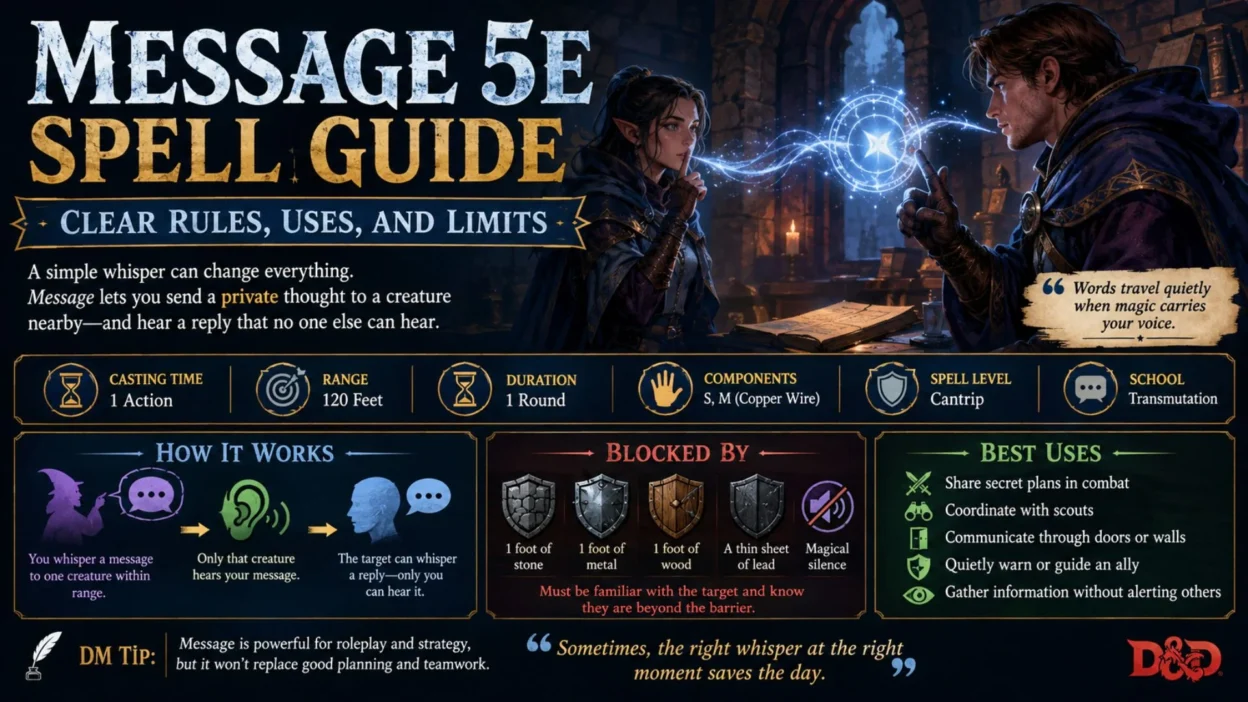
The Message 5e spell lets a character send a private whisper to a nearby creature. The target can also whisper a reply that only the caster hears.
At first, the spell may seem simple. However, it can become very useful during secret talks, scouting, rescue plans, and tense social scenes.
Because Message is a cantrip, it does not use a spell slot. Therefore, a caster can use it many times during an adventure.
Still, the spell has clear limits. Its range is short, certain barriers block it, and magical silence stops it.
In addition, the 2024 version differs from the older 2014 spell. So, players should check which rules their group follows.
This guide explains the spell in simple language. It also includes practical examples, common mistakes, and creative uses.
“Message may not deal damage, but the right whisper can change an entire plan.”
What Is the Message 5e Spell?
Message is a transmutation cantrip built for private communication. You choose a creature within range and whisper a message.
Only that creature hears your words. Afterward, the target may whisper a reply that only you can hear.
The current spell has these basic details:
- Spell level: Cantrip
- School: Transmutation
- Casting time: One action
- Range: 120 feet
- Duration: One round
- Components: Somatic and material
- Material: A copper wire
- Saving throw: None
- Attack roll: None
These details come from the current D&D Beyond spell entry.
Since the spell needs no attack roll, it cannot miss in the normal way. Likewise, the target makes no saving throw.
However, the caster must still meet the spell’s range, component, and barrier rules.
How Message 5e Works
First, the caster points toward a creature within 120 feet. Next, the caster whispers the chosen message.
The target hears the words privately. Other nearby creatures do not hear the magical message itself.
Then, the target can whisper a reply. Only the original caster hears that response.
The spell does not say the target must answer. Therefore, the creature may remain silent.
Also, Message does not force honesty. A target can reply with the truth, a lie, or a misleading answer.
For that reason, Message supports communication rather than mind control.
Does the Target Need to Be Visible?
The current spell says to point toward a creature within range. However, it does not say that you must see the target.
In addition, the spell allows communication through some solid objects. Therefore, it clearly supports certain unseen targets.
Still, you must know where the creature is well enough to point toward it. When doubt remains, the Dungeon Master decides how much knowledge is enough.
For example, you may know that your ally stands behind a wooden door. In that case, you can point toward the door and cast Message.
On the other hand, guessing that someone might be somewhere inside a large castle may not be enough.
Message 5e Range Explained
Message has a range of 120 feet. Therefore, the target must remain within that distance when you cast the spell.
That range works well inside:
- 🏰 Castle rooms
- 🌲 Small forest camps
- ⚔️ Battle maps
- 🕯️ Hidden tunnels
- 🏘️ Nearby buildings
- 🚢 Large ships
- 🪨 Short cave paths
- 🎭 Crowded halls
However, 120 feet does not cover long-distance travel. It cannot reach someone across a city or another plane.
For longer communication, spells such as Sending serve a different role. The current Sending spell has unlimited range and carries up to 25 words.
Therefore, Message works best for nearby secret contact. Meanwhile, Sending works better for distant communication.
Can Message 5e Pass Through Walls?
Yes, Message can pass through some solid objects. However, the spell places clear limits on that ability.
Under the current rules, you must be familiar with the target. You must also know that the creature is beyond the barrier.
The current spell is blocked by:
- Magical silence
- One foot of stone
- One foot of metal
- One foot of wood
- A thin sheet of lead
These limits appear in the current spell text.
Therefore, a normal wooden door may not stop the spell. A very thick wall, however, may block it.
Lead is especially effective. Even a thin lead sheet stops Message completely.
This rule can create interesting scenes. For example, a guarded room may use lead lining to prevent magical contact.
What Does “Familiar With the Target” Mean?
The spell does not provide a detailed measure for familiarity. Therefore, the Dungeon Master may need to judge each case.
Usually, an ally, friend, guard, or person you recently met may count as familiar. Meanwhile, a total stranger behind a wall may not.
A simple test can help:
- Have you met the creature?
- Can you clearly identify them?
- Do you know they are beyond the barrier?
- Can you point toward their location?
When most answers are yes, the spell will usually make sense.
However, Message should not act like a creature detector. You cannot point at every wall and discover hidden enemies through failed whispers.
The spell supports contact with a known target. It does not automatically reveal who is nearby.
Message 5e Components Explained
The current Message spell uses somatic and material components. It does not list a verbal component.
A somatic component requires a hand movement. Meanwhile, the material component is a copper wire.
Under the 2024 spellcasting rules, a caster needs one free hand for somatic movement. The same hand can also handle the material component.
Because the copper wire has no listed cost, many casters can use a component pouch instead. A suitable spellcasting focus may also replace it.
Is the Whisper a Verbal Component?
The current version does not include a verbal component. However, the spell still tells the caster to whisper a message.
Therefore, the whispered words are part of the spell’s effect rather than a listed verbal component.
Even so, magical silence still blocks Message because the spell says so directly. This limit applies even without a verbal component.
That difference matters during stealth scenes. A caster avoids a formal verbal component, yet the spell still involves a quiet whisper.
Does Message 5e Require Concentration?
No, Message does not require concentration. Its duration is one round, and the spell entry does not include concentration.
Therefore, you can cast Message while keeping another concentration spell active.
For example, a wizard can maintain Invisibility on another creature and still cast Message.
However, casting another spell may create separate risks. The situation depends on the other spell, nearby enemies, and the current scene.
Message 5e: 2024 Rules Versus 2014 Rules
The 2014 version is now marked as Legacy on D&D Beyond. Meanwhile, the newer spell entry reflects the current rules.
Both versions share several features:
- They are transmutation cantrips.
- They use one action.
- They have a 120-foot range.
- They last one round.
- The target can whisper a private reply.
However, some details changed.
The 2014 spell uses verbal, somatic, and material components. In contrast, the current version uses only somatic and material components.
The older version also uses different barrier limits. It is blocked by one foot of stone, one inch of metal, thin lead, or three feet of wood.
By comparison, the current version uses one foot for stone, metal, or wood. Thin lead still blocks it.
In addition, the 2014 wording says the spell can travel around corners and through openings. That sentence does not appear in the current entry.
Therefore, always confirm which version your campaign uses. Otherwise, players and Dungeon Masters may remember different rules.
Best Uses of Message 5e During Exploration
Message becomes useful when a group must stay quiet or separated. Because it is a cantrip, it does not use a spell slot.
However, each casting targets only one creature. It also takes one action and lasts for one round.
Coordinate With a Scout
A rogue may move ahead to check a hallway or hidden room. Meanwhile, the caster can remain near the rest of the party.
Once the scout finds something important, Message can provide a private way to reply.
For example, the caster might whisper:
“Did you find any guards beyond the door?”
The scout can then send a short answer. As a result, the party gains useful details without shouting.
Still, the scout must remain within 120 feet. Thick barriers may also block the spell.
Communicate Through a Door
Message can pass through certain solid objects. Therefore, it may help when an ally stands behind a normal door.
You must know that the target is beyond the barrier. In addition, the creature must be familiar to you.
This use may help during:
- 🚪 Locked-room rescues
- 🏰 Castle searches
- 🪤 Trap-filled halls
- 🕯️ Hidden meeting scenes
- ⛓️ Prison escapes
- 🌲 Divided travel groups
However, the spell cannot pass through every wall. Stone, wood, metal, lead, and magical silence may stop it.
Check on a Missing Ally
Suppose a party member disappears around a corner. Message may help you check whether they are safe.
First, point toward the place where you believe they are. Then, send a short question.
A reply confirms that the ally can hear you. However, no reply does not prove that they are gone.
The target may choose not to answer. A wall may also block the spell.
Therefore, Message should not work like a magical tracking tool.
Message 5e Uses During Combat
Message can work during combat, but it has a cost. Casting it uses an action under the current rules.
As a result, you may give up an attack or another important spell. So, use Message only when the information matters.
Share a Secret Plan
You can warn one ally about a danger that others have not noticed.
For example:
- “The guard near the stairs is under a spell.”
- “Do not open the red door.”
- “Protect the healer during the next turn.”
- “The real enemy is hiding near the statue.”
- “Retreat through the eastern hallway.”
A short warning may prevent a serious mistake. However, the spell does not give extra movement or actions.
The ally still follows the normal turn order.
Speak Without Alerting Every Creature
Only the chosen target hears the magical message. The target’s whispered reply is also heard only by the caster.
Therefore, the spell may help during a tense fight with several groups.
For instance, you might speak privately to a guard who is unsure which side to support.
Still, Message is not fully hidden magic. The current spell uses somatic and material components. Therefore, creatures may notice your hand movement or copper wire. This conclusion follows from the listed components and general spellcasting rules.
Ask an Ally for Information
Message can help when one character sees something the rest of the party cannot.
For example, a flying ally may notice danger above the battlefield. A hidden rogue may also see an enemy preparing an ambush.
The caster can ask one clear question. Next, the ally can reply with the most useful detail.
However, long talks waste valuable turns. Keep each combat message short and direct.
Message 5e for Stealth and Infiltration
Private contact can improve a quiet mission. Even so, Message does not make every part of spellcasting unseen.
The spell has somatic and material components. Therefore, the caster needs the required hand movement and material access.
Coordinate a Distraction
One character may wait near a gate. Meanwhile, another party member hides inside the building.
Message can help both characters act at the right time.
For example:
“Create the distraction when the next guard leaves.”
This plan feels more controlled than guessing. As a result, the group may avoid a loud mistake.
Warn Someone During a Social Scene
A character may notice that a noble is lying. However, speaking openly could ruin the meeting.
Message allows the caster to warn one nearby ally privately.
Possible messages include:
- “Do not accept the offer yet.”
- “The advisor knows more than he admits.”
- “Watch the servant near the window.”
- “The key is hidden beneath the desk.”
- “Let me answer the next question.”
Still, the spell does not control the target. The ally can ignore your warning.
Pass a Private Question
Message works well during a busy feast, market, or council meeting.
You might ask:
“Did you recognize the person who entered?”
The target can reply without creating a public discussion.
However, the spell does not translate languages. Its text gives no special language feature. Therefore, the target normally needs to understand the words you send. This is a rules-based inference from the spell’s wording.
What Message 5e Cannot Do
Understanding the limits prevents arguments during play.
It Cannot Read Thoughts
Message sends spoken words. It does not reveal memories, emotions, or hidden plans.
Therefore, it cannot replace Detect Thoughts.
It Cannot Force a Reply
The target can reply, but the spell does not require an answer.
A frightened prisoner may stay silent. Likewise, an enemy may refuse to help.
It Cannot Force the Truth
Message has no charm or truth effect.
Therefore, a target can lie through the reply. Players should still judge the answer carefully.
It Cannot Reach Every Distance
The spell has a range of 120 feet. So, it cannot carry a message across a town, kingdom, or plane.
For distant contact, another spell may be needed.
It Cannot Contact a Whole Group
Each casting chooses one creature. Therefore, every additional target needs another casting.
This limit matters during combat because each casting takes an action.
It Cannot Work Through Magical Silence
The spell clearly states that magical silence blocks it.
This rule applies even though the current spell does not list a verbal component.
Common Message 5e Mistakes
Players sometimes give Message more power than its rules provide.
Avoid these common mistakes:
- Treating the spell like unlimited telepathy
- Sending one message to several creatures
- Ignoring the 120-foot range
- Forgetting the action cost
- Using it through any wall
- Treating silence as harmless
- Assuming the target must reply
- Believing every answer must be true
- Using it to find unknown creatures
- Assuming the spell translates languages
Instead, follow the written effect first. Then, ask the Dungeon Master about uncertain details.
The 2024 spellcasting rules also explain that results beyond a spell’s stated effects remain under the Dungeon Master’s control.
Creative Message 5e Ideas
A simple spell can create memorable moments when players use it with care.
Try these ideas:
- 🗝️ Give a prisoner steps for an escape.
- 🐉 Warn an ally not to attack a peaceful creature.
- 🎭 Feed helpful words to someone during a speech.
- 🕵️ Ask a hidden scout for a guard count.
- 🏰 Contact a friend beyond a nearby door.
- ⚔️ Share a retreat plan during battle.
- 💎 Warn a teammate about a trapped object.
- 🌲 Keep contact while moving through thick woods.
- 👑 Send advice during a royal meeting.
- 🧙 Ask another caster to identify a strange effect.
- 🚢 Coordinate people on different parts of a ship.
- 🪤 Tell an ally where you noticed a hidden trap.
These ideas do not change the rules. Instead, they use the spell’s private contact in useful ways.
As a result, Message can support teamwork without becoming too powerful.
Message 5e Compared With Other Communication Spells
Message works best for quick and private talks between nearby creatures. However, other spells are better for long trips or distant targets.
Knowing the difference helps players choose the right tool.
Message 5e vs. Sending
Message is a cantrip, so it does not use a spell slot. However, it only reaches 120 feet and targets one creature.
Sending reaches across any distance. It can even reach another plane, although delivery may fail in that case.
In addition, Sending allows a message of up to 25 words. The target understands its meaning and may answer at once.
Therefore, choose Message for nearby contact. Use Sending when the target is far away.
Message 5e vs. Animal Messenger
Animal Messenger uses a Tiny Beast to carry up to 25 words. The caster chooses a place and describes the person who should receive it.
The animal then travels toward that location. However, the message is lost if the creature does not arrive in time.
Message is faster because the target hears it at once. On the other hand, Animal Messenger can cover much greater distances.
Therefore, Animal Messenger suits travel scenes. Message works better inside dungeons, homes, camps, and castles.
Message 5e vs. Sending Stones
Sending Stones come as a matched pair. A creature holding one stone can use Sending to contact the person holding the other.
Because the stones are magic items, a character may use them without learning Message.
However, both stones must remain with the right people. Message needs no paired item, although the caster still needs its components.
Tips for Dungeon Masters
Message can support clever play without removing every challenge. Therefore, clear rulings help everyone enjoy the spell.
Follow the Written Limits
First, check the range. Next, consider the barrier between the caster and target.
Message reaches 120 feet. In addition, magical silence and listed materials may block it.
These limits keep the cantrip useful but fair.
Do Not Make It a Tracking Spell
Message should not reveal every hidden creature nearby. The caster must choose a target and point toward it.
When casting through an object, the caster must know the target is beyond that barrier. They must also be familiar with that creature.
Therefore, no reply should remain unclear. Perhaps the target refused, moved away, or could not receive the spell.
Reward Clear Planning
Players often use Message to plan rescues, meetings, and escapes. When the idea follows the rules, let the plan matter.
For example, an ally may warn a prisoner before opening a cell. Another character might share a safe route through nearby rooms.
As a result, the cantrip supports teamwork without solving the full challenge.
Keep Components Meaningful
The spell uses somatic and material components. Its material item is copper wire.
Therefore, a visible guard may notice unusual hand movement. Still, the exact result depends on the scene.
Use common sense rather than making every casting fail. A hidden hand under a table may be harder to notice.
Decide Unclear Details Early
Some situations need a Dungeon Master’s choice. For instance, the rules do not fully define how well the caster must know an unseen location.
Discuss these details before they affect an important scene. As a result, players will understand what to expect.
Roleplaying Ideas for Message 5e
Message can add personality to a character. It does not need to serve only practical plans.
A shy wizard may use it to speak privately during crowded events. Meanwhile, a playful bard may send jokes across a room.
Other roleplaying ideas include:
- 💬 Encouraging a nervous teammate
- 🕵️ Sharing a secret during a formal dinner
- ❤️ Offering comfort without drawing attention
- ⚔️ Warning an ally before danger arrives
- 🎭 Helping a friend during a difficult speech
- 🏰 Contacting someone in a nearby locked room
- 🌲 Checking on a scout in the woods
- 🗝️ Giving escape steps to a prisoner
- 👑 Advising an ally during royal talks
- 🧙 Asking another caster about strange magic
However, avoid using the spell to take control of every conversation. Other characters should still make their own choices.
Instead, treat each whisper as a chance to build trust, tension, or humor.
Frequently Asked Questions About Message 5e
Is Message 5e a cantrip?
Yes. Message is a transmutation cantrip, also called a level 0 spell. Therefore, it does not use a spell slot.
What is the range of Message 5e?
The current version has a range of 120 feet. The chosen creature must be within that range when you cast it.
Can Message 5e go through walls?
Yes, but only through some barriers. The caster must know the familiar target is beyond the object.
However, magical silence, thin lead, or one foot of stone, metal, or wood blocks it.
Can other creatures hear Message?
The chosen target alone hears the magical message. Likewise, only the caster hears the whispered reply.
Still, nearby creatures may notice the casting movement. The situation depends on their view and the Dungeon Master’s ruling.
Does the target have to answer?
No. The spell allows a reply, but it does not force one. Therefore, the target can remain silent.
Can the target lie in its reply?
Yes. Message does not test truth or control thoughts.
As a result, players should judge the answer like any normal statement.
Does Message 5e work inside Silence?
No. The spell directly states that magical silence blocks it.
Can Message contact an unknown creature?
The normal spell lets you point toward a creature within range. However, casting through a barrier also requires familiarity with the target.
Therefore, it should not become a simple tool for finding unknown creatures behind walls.
Is Message 5e Worth Choosing?
Message is a strong choice for campaigns with exploration, secret plans, and social scenes.
It causes no damage. However, that does not make it weak.
A private warning can stop an ambush. Similarly, one quiet question may protect a mission from failure.
The spell becomes less useful in open battles. Using an action for one short message may cost too much.
Even so, its value grows when the party often scouts or divides into nearby groups.
Choose Message when you enjoy:
- Careful planning
- Quiet missions
- Private roleplay
- Team support
- Dungeon exploration
- Social tricks
- Rescue scenes
On the other hand, choose another cantrip when your group mainly needs damage or direct protection.
Conclusion
The Message 5e spell is a simple cantrip with many clever uses. It allows one nearby creature to hear a private whisper and send a reply.
However, the spell has important limits. Its range is 120 feet, barriers may block it, and magical silence stops it.
Therefore, Message works best when players plan carefully. Use it to contact scouts, warn allies, guide prisoners, or share private details.
It cannot read minds or force honest answers. Still, it can create useful plans and memorable roleplaying moments.
Most importantly, keep each message clear. A short whisper at the right time may protect the whole party.