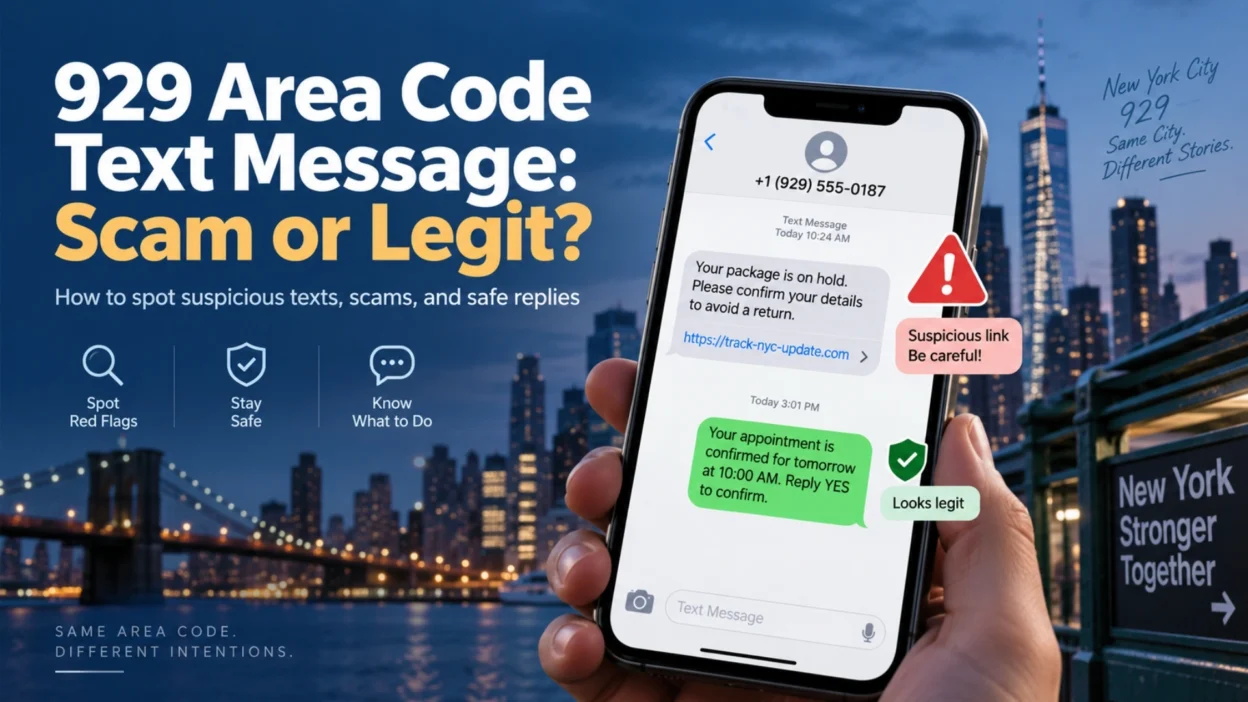
Receiving a 929 area code text message from an unknown number can immediately raise questions. You may wonder who is texting, where the number comes from, and whether replying is safe.
The 929 area code is connected with New York City, but the area code alone cannot tell you whether a message is trustworthy. Therefore, an unexpected text should always be judged by what it says, what it asks you to do, and whether you recognize the sender.
📍 Where Is the 929 Area Code Located?
The 929 area code serves parts of New York City. More specifically, NANPA lists it in the same overlay region as 347, 718, and 917, covering Brooklyn, Queens, the Bronx, Staten Island, and the Marble Hill section of Manhattan. A newer 465 overlay also entered service for this same geographic area in June 2026.
Here is the quick breakdown:
- 🗽 State: New York
- 🌆 Primary region: New York City
- 🏙️ Brooklyn: Covered by the 929 overlay
- 🌉 Queens: Uses 929 numbers
- 🏘️ The Bronx: Included in the service region
- ⛴️ Staten Island: Also covered
- 📍 Marble Hill: Included within the overlay area
- ☎️ Related area codes: 347, 718, 917, and now 465
- 📱 Type: Geographic overlay area code
- 📅 929 entered service: April 16, 2011
So, a 929 phone number is normally associated with the New York City region. However, that fact does not automatically make an unexpected text legitimate.
🤔 Why Am I Getting a Text From a 929 Number?
There are many possible reasons for receiving an unfamiliar message. Some are completely harmless, while others deserve caution.
- 📱 Someone may genuinely have the wrong number.
- 👋 A person you know may be contacting you from a new number.
- 🏢 A business located in New York may be trying to reach you.
- 🚚 A service provider may send an appointment or delivery notification.
- 💼 A recruiter may contact you about a real opportunity.
- 📢 A marketing company might send a promotional message.
- 🤖 An automated system could send an account notification.
- ❌ The message may simply be unwanted spam.
- 🎣 In other cases, it could be a phishing attempt.
- 💰 A scammer may try to begin a conversation before asking for money or information.
Because several explanations are possible, avoid judging a message only by its area code.
⚠️ Is a 929 Area Code Text Message a Scam?
Not every text from 929 is a scam. At the same time, an unfamiliar New York number should not automatically be trusted.
Instead, examine the message itself.
Common warning signs include:
- 🚨 The text creates unnecessary urgency.
- 🔗 It asks you to click an unfamiliar link.
- 💳 Someone requests banking or credit card information.
- 🔐 The sender asks for passwords or verification codes.
- 💵 You are told to send money immediately.
- 🎁 The message claims you unexpectedly won a prize.
- 📦 A delivery problem appears even though you are not expecting a package.
- 🛣️ The sender claims you owe an unpaid toll.
- 💼 You receive a job offer you never applied for.
- 💰 Someone discusses a loan you never requested.
- 👋 A stranger begins with a vague “wrong number” conversation.
- 😨 The text threatens consequences unless you act quickly.
The FTC specifically warns about unexpected texts involving fake bank alerts, package deliveries, toll payments, job opportunities, and wrong-number conversations.
🚩 Common 929 Text Message Scam Examples
Scam messages can use many different stories. However, several patterns appear repeatedly.
📦 Fake Delivery Texts
A message may claim that USPS, FedEx, or another delivery company cannot deliver your package.
Watch for lines such as:
- 📦 “Your package cannot be delivered.”
- 📍 “Please confirm your delivery address.”
- 💳 “Pay a small redelivery fee.”
- 🔗 “Click here to update your shipping details.”
- ⏰ “Your package will be returned unless you respond.”
The FTC recommends checking real delivery information directly through the retailer or carrier instead of using links in unexpected texts.
🛣️ Fake Toll Payment Messages
Another common text claims that you have an unpaid road toll.
The message may say:
- ⚠️ Your toll balance is overdue.
- 💵 You owe a small unpaid amount.
- 🚗 Your vehicle registration may be affected.
- 🔗 You must follow a link to make payment.
- ⏳ Additional penalties will apply if you wait.
Instead of clicking, verify any real toll balance through the official tolling agency independently. The FTC has specifically warned consumers about this type of phishing text.
💼 Fake Job Offer Texts
An unexpected employment opportunity can sound attractive, especially when the sender promises flexible hours or unusually high pay.
Be cautious when:
- 💼 You never applied for the position.
- 💰 The pay seems unusually high for simple work.
- 📲 The recruiter immediately moves the conversation to another messaging app.
- 💳 You are asked to pay an upfront fee.
- 🏦 Someone requests bank information before a proper hiring process.
- 🔗 The message contains an unfamiliar application link.
- ⚡ You are pressured to accept immediately.
The FTC advises people not to respond to unexpected job texts or click their links. Instead, verify the company through contact information you find independently.
💳 Fake Bank and Account Alert Messages
Scammers may also pretend to represent a bank, retailer, payment platform, or other familiar company.
For example, a message could say:
- 🚨 “Suspicious activity was detected.”
- 💳 “Was this purchase yours?”
- 🔐 “Your account has been temporarily locked.”
- 📞 “Call immediately to prevent account closure.”
- 🔗 “Verify your account using this secure link.”
These messages are designed to create fear. As a result, you may react before checking whether the alert is genuine.
If you are worried, open the company’s official app or visit its official website yourself. Do not use the contact details included in the unexpected message.
👋 What About a “Wrong Number” Text From 929?
You might receive something casual such as:
- 👋 “Hi, are we still meeting tomorrow?”
- 😊 “It was nice seeing you yesterday.”
- 🍽️ “Are you free for dinner tonight?”
- ❓ “Is this Jessica?”
- 📸 “Do you remember me?”
Sometimes, this really is a wrong number. However, scammers also use harmless-looking messages to begin conversations with strangers.
Therefore:
- 🚫 Do not feel obligated to continue the conversation.
- 🔍 Avoid sharing your full name or personal details.
- 📍 Never reveal where you live or work.
- 💼 Be cautious if the conversation quickly moves toward investing or business.
- 💰 Stop immediately if money becomes part of the discussion.
- 🚩 Treat excessive friendliness from a complete stranger cautiously.
The FTC includes “wrong number” texts among common approaches scammers use to get people to respond.
🛡️ What Should You Do With an Unknown 929 Text?
If you do not recognize the sender, a few simple precautions can reduce your risk.
- 🛑 Pause first: Do not react because the message sounds urgent.
- 🚫 Avoid unknown links: Do not open links in unexpected texts.
- 💬 Do not reply: Even a simple response may continue an unwanted conversation.
- 🔐 Protect personal information: Never send passwords, Social Security numbers, or banking details.
- 🏦 Verify independently: Contact banks or companies through their official website or app.
- 📱 Use Report Junk: Most phones offer an option to report suspicious texts.
- 🚫 Block the sender: Block numbers that repeatedly send unwanted messages.
- 🗑️ Delete suspicious texts: Remove them after reporting.
- 📤 Forward spam to 7726: U.S. consumers can forward unwanted texts to 7726 (SPAM).
- 📝 Report serious scams: Suspected fraud can also be reported to the FTC.
The FTC currently recommends reporting unwanted texts through your phone’s junk-reporting feature or forwarding them to 7726 (SPAM).
✅ How to Tell if a 929 Text May Be Legitimate
An unknown number is not automatically dangerous. Instead, look for context that you can verify independently.
A legitimate message may:
- ✅ Relate to something you recently requested.
- 🏥 Confirm an appointment you actually scheduled.
- 📦 Match an order visible inside your real shopping account.
- 🏦 Reference activity you can independently verify through your bank app.
- 👤 Come from someone whose identity you can confirm another way.
- 🏢 Match contact information published by a real business.
Even then, avoid sharing sensitive information through an unexpected text.
When in doubt, open the official app, type the company’s website yourself, or use a trusted phone number you already know.
📲 Can a 929 Number Be Spoofed?
Yes. A phone number appearing on your screen does not always prove where the sender is really located. Scammers can sometimes manipulate caller ID information so that a message looks more familiar or local.
Therefore, do not trust a text only because the number begins with 929.
- 📱 A message may appear to come from New York even when the sender is elsewhere.
- 🏙️ Scammers may use local-looking numbers to increase the chance of a reply.
- 🔍 The displayed number alone cannot confirm the sender’s identity.
- ⚠️ A familiar area code does not make a suspicious link safe.
- 💳 Never share payment information simply because the number looks legitimate.
- 🔐 Verification codes should never be sent to an unexpected texter.
- 🏦 Always contact financial institutions through official channels.
- 📞 If someone claims to represent a company, verify the claim separately.
- 🚫 Avoid trusting caller ID as your only form of verification.
- ✅ Focus on the content and context of the message instead.
🔍 Can You Find Out Who Owns a 929 Number?
Sometimes, you may be able to find public information connected to a phone number. However, reverse phone searches have important limitations.
For example, a number may belong to a mobile user, business, internet-based calling service, or recycled account.
- 🔍 Searching the full number online may reveal business listings.
- 🏢 A legitimate company number may appear on its official website.
- 📱 Mobile numbers often have little public information.
- 🔄 Phone numbers can be reassigned to new users over time.
- 🌐 Internet-based numbers may not match the sender’s physical location.
- ⚠️ Free lookup websites may contain outdated or inaccurate information.
- 💰 Avoid paying unknown websites simply to identify a suspicious texter.
- 🔐 Never enter sensitive personal information into questionable lookup sites.
- 📞 If the sender claims to be a company, check that company directly.
- ✅ Treat reverse lookup results as clues rather than proof.
As a result, identifying the owner may not always be possible. More importantly, you usually do not need to identify the person before blocking a clearly suspicious message.
💵 929 Area Code Money and Payment Scams
Requests for money should immediately increase your level of caution. Legitimate organizations usually provide clear ways to verify charges independently.
Be especially careful when a text asks for:
- 💳 Credit or debit card numbers.
- 🏦 Bank account information.
- 💸 Wire transfers.
- 🎁 Gift card payments.
- 📲 Payments through unfamiliar apps.
- ₿ Cryptocurrency transfers.
- 💰 Small “processing” fees before receiving a prize.
- 📦 Delivery fees through an unexpected link.
- 🚗 Unpaid toll payments through a suspicious website.
- 💼 Fees before starting a new job.
Scammers often create urgency because they do not want you to stop and investigate.
Therefore, phrases such as “pay immediately,” “final notice,” or “your account will close today” deserve extra caution.
🔐 929 Verification Code Text Scams
Verification codes help protect online accounts. However, scammers may try to convince you to send them a code that was meant only for you.
A suspicious conversation may look like this:
- 📲 You unexpectedly receive a security code.
- 💬 Someone texts and claims the code was sent to you by mistake.
- 🙏 They politely ask you to send the number back.
- 🔐 In reality, the code may provide access to your account.
- 🚨 Once shared, the scammer may be able to complete a login or reset.
Therefore:
- ❌ Never send verification codes to strangers.
- 🔐 Keep one-time passwords private.
- 📱 Check which service sent the code.
- 🔑 Change your password if you notice suspicious login attempts.
- ✅ Enable stronger account security when available.
Even when the request sounds harmless, a verification code should stay private.
❤️ Romance and Friendship Text Scams
Some scams begin slowly. Instead of immediately asking for money, the sender may spend days or weeks building trust.
The first message might seem casual:
- 👋 “Sorry, I think I texted the wrong person.”
- 😊 “You seem really kind.”
- 💬 “Maybe we can still be friends.”
- 📸 “Can I send you my picture?”
- 🌍 “Where are you from?”
- 💼 “What do you do for work?”
At first, nothing may seem dangerous. However, the conversation can gradually become more personal.
Watch for these warning signs:
- 🚩 The stranger becomes emotionally close unusually quickly.
- 💰 Investing or cryptocurrency suddenly enters the conversation.
- ✈️ The person repeatedly has excuses for not meeting.
- 📲 They want to move to another messaging app immediately.
- 🏦 They eventually ask for financial help.
- 🔐 They request personal information.
- 📸 They pressure you to exchange private photos.
- 🎁 They promise gifts but ask you to pay a fee first.
So, while friendliness itself is not suspicious, rapid emotional pressure combined with money requests is a serious warning sign.
💼 929 Area Code Job Text Scams
Job scams can be especially convincing because they may mention real company names or common remote-work opportunities.
A suspicious job text may promise:
- 💰 Very high pay for simple tasks.
- 🕐 Extremely flexible hours with little experience required.
- 📱 Hiring completely through text messages.
- ⚡ Immediate acceptance without a proper interview.
- 💳 Payment after you send an upfront fee.
- 📦 Money for purchasing equipment through an unfamiliar process.
- ⭐ Earnings for liking videos or rating products.
- 💸 Bonuses for depositing your own money first.
- 🪙 Cryptocurrency payments for completing “tasks.”
- 👥 Extra income for recruiting other participants.
Before responding, search for the employer independently and visit its official careers page.
Moreover, never pay someone just to receive a normal job opportunity.
🛍️ Fake Purchase and Refund Texts
Another common approach is to make you believe an expensive purchase has been charged to your account.
The text may say:
- 💳 “Your card was charged $499.”
- 📱 “Your smartphone order has been confirmed.”
- 🛒 “Thank you for your recent purchase.”
- 🚨 “Contact us immediately if you did not authorize this.”
- 📞 “Call this number to cancel your order.”
The goal is often to make you panic and contact the scammer.
Instead:
- 🏦 Check your actual bank or card account.
- 🛍️ Open the retailer’s official app.
- 📞 Call the company using a verified number.
- 🚫 Do not call numbers listed only in suspicious texts.
- 🔗 Avoid links included in unexpected purchase alerts.
If no transaction appears in your real account, the message may simply be bait.
🎁 Prize and Giveaway Text Messages
Winning something unexpectedly can feel exciting. However, legitimate prizes should not require you to pay mysterious fees before receiving them.
Be cautious if the message claims:
- 🎉 You won a contest you never entered.
- 💰 You won a large cash prize.
- 📱 You were randomly selected for a new phone.
- 🎁 A major retailer chose you for a gift card.
- 🚗 You won a vehicle.
- 🏖️ You received a free vacation.
- 💳 You must pay taxes or processing fees first.
- 🔗 You need to enter banking details to claim the reward.
A useful rule is simple: if you did not enter a contest, treat an unexpected winning message with suspicion.
📦 How to Check a Delivery Text Safely
Package messages are common because many people shop online. As a result, scammers know that a delivery story may feel believable.
Before clicking anything:
- 📦 Think about whether you are actually expecting a package.
- 🛒 Check your order directly through the retailer.
- 🚚 Open the carrier’s official website or app yourself.
- 🔢 Enter the tracking number manually when you have one.
- 🔗 Avoid shortened or unusual links.
- 💳 Do not enter payment information into an unexpected delivery page.
- 📍 Be cautious when asked to “correct your address” through a random link.
- 🗑️ Delete the message if you cannot verify it.
- 🚫 Block repeated suspicious senders.
- 📤 Report spam when appropriate.
This process takes only a moment and can prevent a much larger problem.
🧠 Questions to Ask Before Replying to a 929 Text
Before responding, stop and ask yourself a few questions.
- ❓ Do I know this person or organization?
- 📱 Was I expecting this message?
- 🔗 Does the text contain a suspicious link?
- 💰 Is someone asking for money?
- 🔐 Are they requesting personal or security information?
- ⏰ Is the message trying to create panic or urgency?
- 🏢 Can I verify the sender using an official website?
- 📝 Does the message contain unusual grammar or wording?
- 🎁 Is the offer unusually generous?
- 🚩 Does something simply feel inconsistent or strange?
If several warning signs appear together, do not engage.
🚫 Should You Reply “STOP” to a 929 Scam Text?
For legitimate marketing messages, replying STOP can unsubscribe you from future texts.
However, an obvious scam or completely unknown message is different.
- ✅ Use STOP for a business you recognize and previously interacted with.
- 🚫 Avoid engaging with obviously fraudulent messages.
- 📱 Use your phone’s block and report features instead.
- 🗑️ Delete suspicious messages after reporting them.
- 🔗 Never click an unsubscribe link inside a questionable text.
- 🔐 Do not provide information to prove your identity.
- 📤 Report unwanted spam when appropriate.
The goal is to avoid giving a suspicious sender more opportunities to interact with you.
🛡️ How to Protect Yourself From Future Scam Texts
A few habits can make unexpected messages much easier to handle.
- 🔐 Use strong, unique passwords for important accounts.
- 📲 Turn on multi-factor authentication when available.
- 🚫 Never share one-time verification codes.
- 🔗 Avoid opening unexpected links.
- 🏦 Verify financial alerts through official apps.
- 📱 Enable spam filtering features on your phone.
- 🧠 Slow down whenever a message creates urgency.
- 💳 Never send money to an unknown texter.
- 📤 Report suspicious messages instead of forwarding them to friends.
- 👨👩👧 Warn family members about new scam patterns.
- 🧓 Help older relatives recognize fake payment requests.
- ✅ When uncertain, verify first and respond later.
Ultimately, the safest response to an unexpected 929 area code text message is not panic. Instead, pause, verify the sender independently, and protect your personal information before taking any action.
📞 What If the 929 Text Claims to Be From a Bank?
Bank-related texts deserve extra caution because scammers often use fear to make people act quickly.
If a message claims there is suspicious activity:
- 🏦 Open your bank’s official app instead of using the text link.
- 📞 Call the number printed on the back of your bank card.
- 🔐 Never send your password or security code by text.
- 💳 Do not confirm card details through an unknown number.
- 🚨 Ignore threats that your account will close immediately.
- 🔗 Avoid links that ask you to “verify” your identity.
- 💰 Never transfer money to a so-called “safe account.”
- ✅ Check your real transaction history before taking action.
- 🛑 Stop the conversation if the sender becomes pushy.
- 📱 Block the number once you confirm the message is fake.
A real financial concern should always be checked through a trusted channel.
🚗 What If the Message Says You Owe a Toll?
Toll scams often use small amounts because they seem believable. However, the message may lead to a fake payment page designed to collect card information.
Watch for signs such as:
- 🚗 A toll notice you were not expecting.
- ⏰ A very short deadline to pay.
- 💵 A small balance followed by a much larger penalty threat.
- 🔗 A strange or shortened website link.
- 📍 A toll agency you do not recognize.
- 💳 A request for immediate card payment.
- 🚨 Threats involving registration or legal action.
- 📲 Repeated texts from different numbers.
- ❌ Poorly written or unusual wording.
- 🛣️ No matching record in your official toll account.
Instead, visit the real toll agency website directly and check your account there.
📦 What If the 929 Text Says Your Package Is Delayed?
Package scams are especially effective because online deliveries are common.
Before responding:
- 📦 Check whether you are actually expecting a delivery.
- 🛍️ Open the retailer’s official order page.
- 🚚 Check tracking through the carrier’s official website.
- 🔗 Do not click unexpected delivery links.
- 💳 Avoid paying a small “redelivery” fee through a text.
- 📍 Do not enter your home address into a suspicious page.
- 🔐 Never provide account passwords.
- 📱 Ignore messages that create unnecessary urgency.
- 🗑️ Delete the text if the delivery cannot be verified.
- ✅ Use your real tracking number instead.
Even a message that looks professional can still be fake.
🧾 What If the Text Mentions Taxes, Debt, or Government Payments?
Messages that mention government agencies or unpaid debts can feel intimidating. Therefore, scammers may use them to pressure people into responding quickly.
Be cautious if the sender:
- ⚠️ Threatens immediate arrest.
- 💰 Demands instant payment.
- 🎁 Requests gift cards.
- ₿ Wants cryptocurrency.
- 📲 Insists that you communicate only by text.
- 🔐 Asks for sensitive identification details.
- 🔗 Sends an unfamiliar payment link.
- ⏰ Gives you an extremely short deadline.
- 😨 Uses fear to stop you from checking independently.
- 🚫 Tells you not to contact anyone else.
Legitimate financial or government issues should be verified through official websites or known phone numbers.
👤 What If the Sender Knows Your Name?
Knowing your name does not automatically prove that the sender is legitimate.
Personal information can sometimes come from:
- 🌐 Public social media profiles.
- 🏢 Business directories.
- 📋 Marketing databases.
- 📱 Old online accounts.
- 🔓 Previous data breaches.
- 👥 Public professional profiles.
- 🛍️ Shopping or loyalty accounts.
- 📞 Shared contact lists.
- 📝 Public records.
- 💻 Information posted online years ago.
Therefore, a stranger saying your name should not be enough to earn your trust.
🔐 Information You Should Never Send by Text
Sensitive information can help scammers access your accounts or impersonate you.
Avoid sharing:
- 🔑 Passwords.
- 🔐 One-time verification codes.
- 🏦 Bank account numbers.
- 💳 Full credit card details.
- 🪪 Social Security numbers.
- 📅 Complete date of birth when unnecessary.
- 📍 Home address with other personal details.
- 📸 Copies of identity documents.
- 🔢 PIN numbers.
- 💰 Cryptocurrency wallet recovery phrases.
- 📧 Email login information.
- 🖥️ Remote access codes.
If someone unexpectedly asks for these details, stop the conversation.
🚨 What to Do If You Already Clicked the Link
Clicking a suspicious link does not always mean your accounts have been compromised. However, quick action can reduce your risk.
- 🛑 Close the website immediately.
- 🔐 Change passwords if you entered login details.
- 📲 Enable multi-factor authentication.
- 🏦 Contact your bank if you entered financial information.
- 💳 Watch your card transactions closely.
- 📱 Remove suspicious apps if anything was downloaded.
- 🔄 Update your phone and browser.
- 🧹 Run a trusted security scan when appropriate.
- 📧 Check your email for unexpected password resets.
- 🚫 Block the sender.
- 📝 Report the suspicious message.
- 👀 Continue watching important accounts for unusual activity.
The faster you respond, the easier it may be to prevent further problems.
💳 What to Do If You Sent Money
If money has already been sent, act as soon as possible.
- 🏦 Contact your bank or payment provider immediately.
- 💳 Ask whether the transaction can be stopped or disputed.
- 🎁 If gift cards were used, contact the card issuer.
- 💸 Report suspicious payment-app transfers through the app.
- ₿ Cryptocurrency transactions can be difficult to reverse, so report them quickly.
- 🧾 Save screenshots and transaction records.
- 📱 Keep the scammer’s phone number.
- 📧 Save related emails or messages.
- 📝 File a fraud report when appropriate.
- 🔐 Change passwords if account information was also shared.
Do not send additional money to someone who promises to recover your first payment.
📱 Should You Block a 929 Area Code Number?
Blocking makes sense when the message is clearly unwanted, suspicious, or repeatedly sent.
You may want to block the number when:
- 🚫 You do not know the sender.
- 🔗 The message contains suspicious links.
- 💰 Someone asks for money.
- 📢 The number repeatedly sends unwanted promotions.
- 😨 The sender uses threats or pressure.
- 🤖 The messages appear automated and irrelevant.
- 👋 A stranger keeps trying to continue a wrong-number conversation.
- 📲 You receive repeated scam-style messages.
- 🔐 The sender requests personal information.
- ❌ You have already confirmed the text is fraudulent.
However, blocking one number may not stop every spam message because senders can use different numbers.
📤 How to Report a Suspicious 929 Text
Reporting suspicious messages can help reduce future spam.
Common options include:
- 📱 Use the “Report Junk” or “Report Spam” feature on your phone.
- 🚫 Block the number after reporting.
- 📤 Forward unwanted texts to 7726 when supported by your carrier.
- 📝 Report serious fraud attempts to the appropriate consumer protection agency.
- 🏦 Notify your bank if the scam impersonates your financial institution.
- 📦 Tell the real delivery company if its name is being misused.
- 🛍️ Report fake retailer messages to the actual company.
- 💼 Notify a company if scammers are using its name for fake job offers.
- 👨👩👧 Warn family members when you notice a convincing scam pattern.
- 🧓 Pay special attention to relatives who may be less familiar with text scams.
Reporting takes only a few moments and may help protect other people.
✅ Quick 929 Text Message Safety Checklist
Before trusting any unexpected message, check these points:
- ✅ Do you recognize the sender?
- ✅ Were you expecting the message?
- ✅ Can you verify the claim independently?
- ✅ Does the link use the company’s real domain?
- ✅ Is the sender avoiding pressure or threats?
- ✅ Are they asking only for reasonable information?
- ✅ Does the message match something you recently did?
Now check for warning signs:
- 🚩 Unexpected payment request.
- 🚩 Strange link.
- 🚩 Prize you never entered to win.
- 🚩 Job you never applied for.
- 🚩 Verification-code request.
- 🚩 Sudden investment opportunity.
- 🚩 Threat of immediate consequences.
- 🚩 Request for gift cards or cryptocurrency.
- 🚩 Pressure to act without checking.
- 🚩 A stranger becoming unusually friendly very quickly.
If several red flags appear, the safest choice is usually not to respond.
❓ Frequently Asked Questions
Where is the 929 area code from?
The 929 area code is associated with New York City and serves areas including Brooklyn, Queens, the Bronx, Staten Island, and Marble Hill.
Is a 929 area code text message always a scam?
No. Many legitimate people and businesses use 929 numbers. However, an unexpected message should still be verified before you click links, send money, or share personal information.
Why am I getting random texts from 929 numbers?
Possible reasons include wrong numbers, marketing messages, legitimate business communication, automated alerts, spam, or scam attempts.
Should I reply to an unknown 929 text?
If you do not recognize the sender and the message has no clear legitimate context, it is usually safer to avoid replying until you can verify who sent it.
Can a scammer use a 929 phone number?
Yes. Scammers can use phone numbers from many area codes. In addition, displayed phone information does not always prove the sender’s true identity or location.
What should I do if a 929 number sends me a suspicious link?
Do not click the link. Instead, verify the message through the official website, app, or trusted contact details of the company involved.
Is it safe to reply STOP?
Replying STOP is useful for legitimate marketing messages from companies you recognize. However, when a message appears fraudulent, blocking and reporting it may be safer than engaging.
What if the sender says they texted the wrong number?
A genuine mistake is possible. Still, be cautious if the stranger tries to continue chatting, asks personal questions, or eventually discusses money, investments, or cryptocurrency.
How can I check whether a 929 number is legitimate?
Search the full number, compare it with the organization’s official contact information, and verify any claim through an independent source. Do not rely on the area code alone.
📌 Conclusion
A 929 area code text message can come from a legitimate New York City number, but the area code itself does not prove that the sender is trustworthy; therefore, when an unexpected message asks you to click a link, send money, share personal information, reveal a verification code, or act immediately, pause before responding, verify the claim independently through an official website or trusted contact method, and block or report suspicious messages when needed because a few extra minutes of checking can protect your accounts, money, and personal information.